

Fibre optics · operations
fibero
Order and clarity in day-to-day fibre-optic work: job, billing and finance logic.
Status
Live
In daily operation
Market
DE
Sector
Fibre optics · operations
The application in use
The application in use
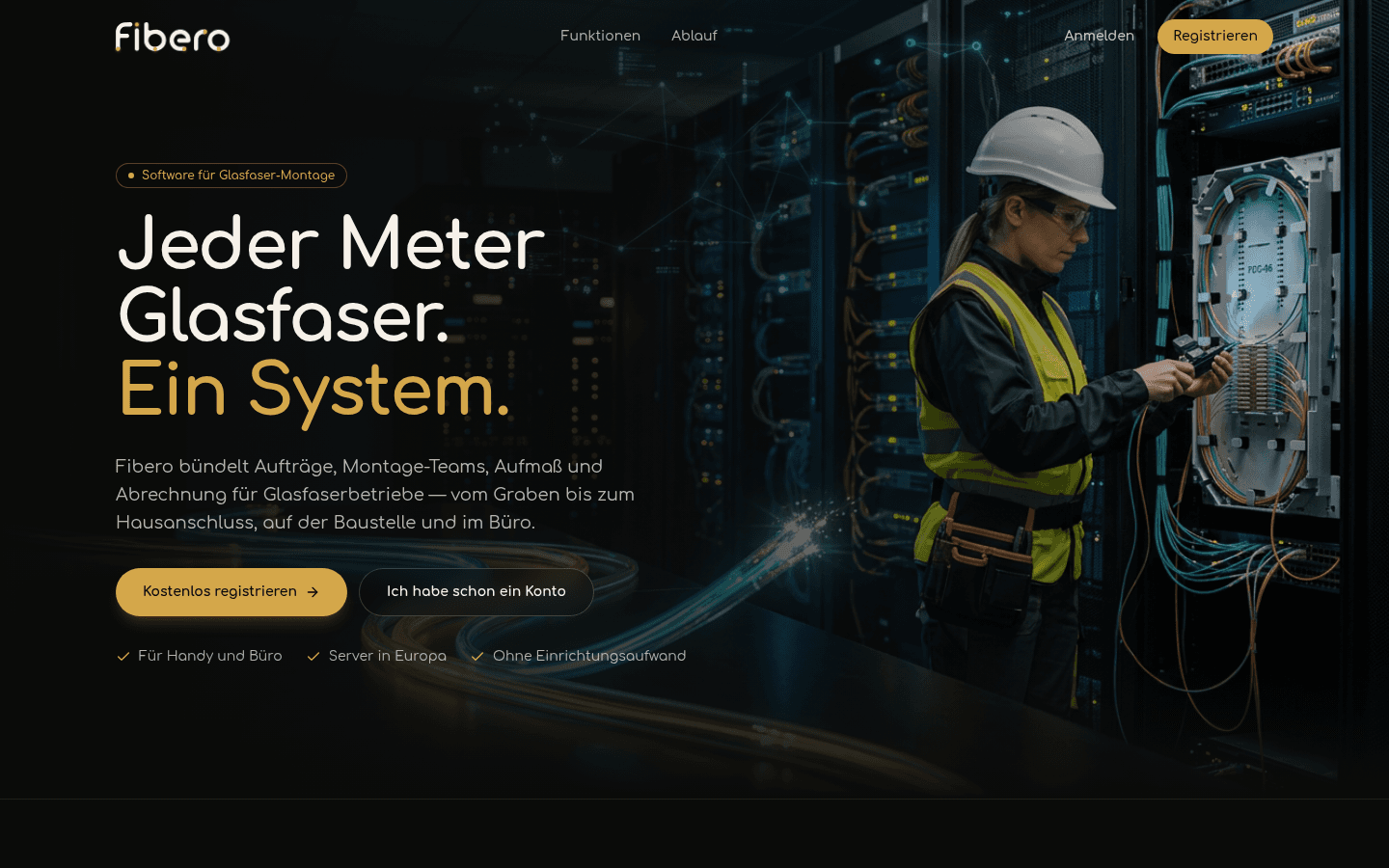
This is the application in use, not the interface screen by screen. We will show full captures once we can take them from a demo instance with invented data — until then this is the picture that exists, not one that claims more.
Our own operation, not a customer case
What creaDIG works with itself.
fibero is not sold here and is not a customer project. It is creaDIG's fibre-optic arm — our own crew, subcontractors, jobs, invoices in both directions. What follows is readable in this system's source; read on 11 September 2026.
The process
Fibre-optic rollout means jobs at addresses. A crew or a subcontractor drives out, surveys, prepares, executes — or aborts. Out of that come an outgoing invoice to the client, incoming invoices from subcontractors, receipts, mileage and, at the end, a report for the tax adviser.
Where the system takes hold
- The same job data reaches the business in three forms: as a subcontractor's PDF invoice, as an Excel list, or by hand.
- The job type decides the billing — survey, first job, follow-up, preparation, cancellation, bulk, on-site abort, extra effort. As free text it cannot be computed.
- An on-site abort is not a cancellation. Treat the two alike and you bill wrongly.
- Receipts arrive as till slips, as invoices and by email — and have to end up in a report a tax adviser can read.
What the system makes of it
- An object is the one record: address, date, crew, fitter. Everything else hangs off it.
- The three origins run into the same record — with a note of where it came from and from which source.
- The job type sits in eight counted fields, not in text. Extra effort applies only to our own crew; an abort is never billable.
- Every imported fact carries a review state: open or reviewed. What the machine pulled out of a PDF counts only afterwards.
- From the same facts come the outgoing invoice and the reconciliation of incoming invoices.
- Receipts are collected from the mailbox, read out and categorised — with a note of what is deductible.
- At the end there is a pack for the tax adviser and a DATEV export from the same stock.
- Who changed what is in the audit log.
What this can be measured by
- How many objects came about in a period
- How many of them came from PDF, Excel or hand entry
- How many facts are still unreviewed
- How long an object takes from creation to completion
- How many receipts arrived automatically
What this proves — and what it does not
What is proven is the structure: a case comes about once and then carries billing, the receipt trail and the tax report. That is readable in the schema and not a matter of taste.
What is not proven is a time saving. There is no record of how long the same cases took before — without a before-measurement any percentage would be back-calculated. What such an effect would be worth in your business, you can work out with your own numbers.
Work it out with your own numbersWhat fibero does not do
- It is not sold and has no price list.
- It has no public address — it runs inside our own operation.
- It is not a customer project and no evidence that a customer was satisfied. Released customer work is under Work; today there is none.
- It does not plan deployments. Planning lives in another system, against which fibero reconciles.
Why this is here
Because it answers the question that stands before every system project: does this house understand an operational process far enough to translate it into data fields — including the cases you only notice in operation? An on-site abort that is not a cancellation appears in no specification document. It appears in this schema.
What we built
Built ourselves, block by block.
Building blocks
Operational processes
Billing system
Reporting
Where it sits in the system
Operations
Every product of ours sits on one of the five levels — and we offer that same level as a service. What we have built here, we also build for your business.
View levelMatching services
Feedback
Found something?
Anyone working with fibero who hits a fault or a missing piece reports it here — not through the contact form, which asks about a project.
Muhammed Emin Akyol, direkt — fibero läuft im eigenen Glasfaser-Alltag — for faults and requests
Register interest
Shall we let you know?
If fibero is of interest for your business: leave an address and we will get in touch once it is ready. No newsletter, no advertising — one message about this product.
Does this fit your business?
Twenty minutes, free and without obligation. We look at the operation and tell you honestly whether we can help.